
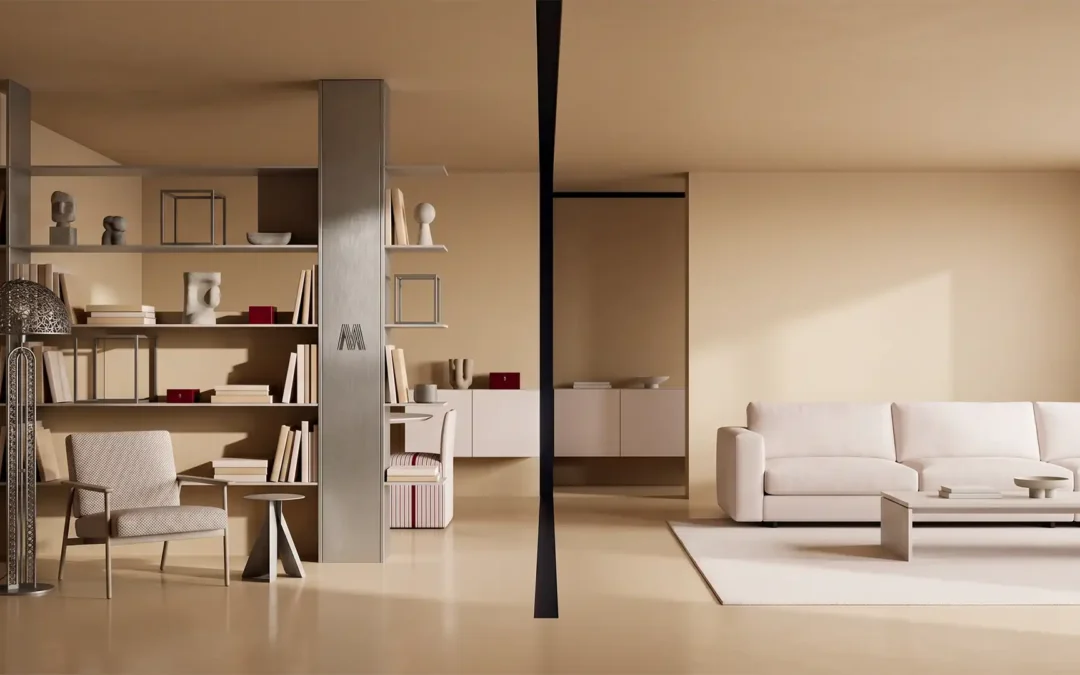
A living room is rarely questioned once it is furnished.
It appears complete. Functional. Visually acceptable.
Yet beneath that surface, it operates as a psychological system.
Every color, proportion, and material condition the way people sit, speak, relax, and even think.
Interior design, at its highest level, is not about arrangement.
It is about influence.
Design Does Not Fill Space. It Programs Behavior.
Most residential spaces are designed reactively.
Furniture is placed. Colors are selected. Materials are combined.
But without structure, the space becomes visually assembled, not intentionally constructed.
A well-designed living room anticipates behavior:
- Where attention is directed
- How movement flows
- How long occupants remain engaged
- Whether the environment calms or stimulates
This is not decoration.
It is spatial programming.
Color Is Emotional Architecture
Color is often treated as a finishing decision.
In reality, it is one of the strongest psychological drivers in a space.
Warm tones tend to compress perception, creating intimacy and social engagement.
Cool tones expand perception, introducing calmness and cognitive distance.
But the impact is not only emotional.
It is behavioral.
A living room dominated by high-contrast or saturated tones may increase visual stimulation, reducing the ability to relax.
A restrained palette, by contrast, reduces noise and allows presence.
Color is not seen.
It is experienced over time.
The question is not which colors look better.
The question is which colors allow the space to perform its intended role.
Spatial Planning Defines Interaction
Furniture placement is often misunderstood as a layout exercise.
It is, in reality, a decision about human relationships within space.
Distance between seating defines intimacy.
Orientation defines communication.
Circulation paths define comfort.
When spatial planning lacks intention, the result is subtle discomfort:
- Conversations feel forced
- Movement feels restricted
- The space feels visually complete but functionally unresolved
A structured layout aligns movement, sightlines, and interaction.
The space begins to feel effortless.
Materials Shape Sensory Perception
Materials are often selected for appearance.
But their true impact lies in how they are experienced through touch, reflection, and absorption.
Soft materials introduce acoustic calm and tactile comfort.
Hard surfaces reflect light and sound, increasing clarity but also intensity.
Natural materials tend to ground the space.
Synthetic finishes, if overused, can create visual detachment.
The balance is critical.
A living room composed without material awareness may appear refined, yet feel cold.
Another may feel comfortable, but visually unstructured.
Material intelligence is what aligns both.
Why Most Living Rooms Fail Silently
Failure in residential design is rarely dramatic.
It does not appear as a broken space.
It appears as a space that never fully works.
The symptoms are subtle:
- Spaces that are rarely used
- Environments that feel visually heavy
- Rooms that do not support relaxation despite comfort elements
These are not aesthetic issues.
They are structural design failures.
Interior Design as a System, Not a Style
A living room should not be defined by trends, themes, or visual references.
It should be defined by how it performs over time.
This requires:
- Intentional color strategy
- Structured spatial planning
- Material balance based on sensory impact
When these elements align, the space becomes more than visually complete.
It becomes psychologically functional.
Conclusion
The living room is not a passive environment.
It is an active participant in daily life.
It shapes behavior quietly, consistently, and over time.
Designing it without psychological awareness is not neutral.
It is a missed opportunity.
Designing it with intention changes how people live within it.
This is the discipline.
Continued perspectives
This discussion continues through our LinkedIn presence.
Selected insights, case perspectives, and system thinking are published continuously.
Visit MoeBak on LinkedIn
Continued thinking
Ideas evolve through systems.
We continue them beyond individual posts.
Selected insights, case perspectives, and structured thinking continue across MoeBak’s broader publication rhythm.